latest news
View more
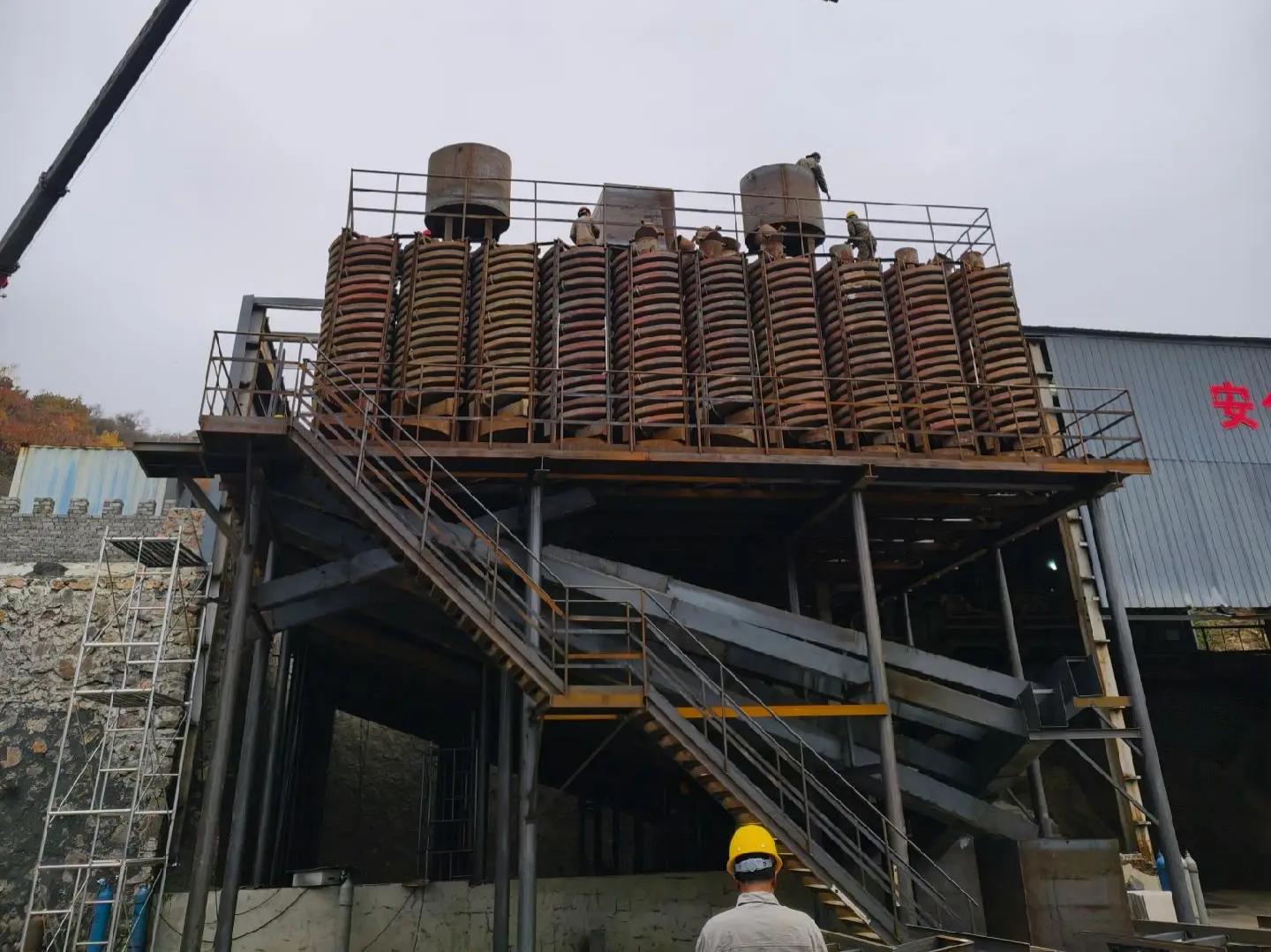
The principle and function of spiral chutes
Time:2026-01-14
Author:
The principle of the spiral chute:
- Separation principle based on density differences: The spiral chute utilizes the varying settling velocities resulting from differences in particle density to achieve separation. After the ore pulp is fed from the top of the spiral trough, under the combined effects of gravity, water flow resistance, centrifugal force, and friction, heavy minerals (such as tungsten and tin) settle rapidly and sink to the lower layer of the liquid flow, while light minerals (such as quartz and feldspar) settle slowly and float on the upper layer of the liquid flow.
- Formation of cross-sectional circulation: When the liquid flow moves along the surface of the spiral trough, it continuously changes direction, generating centrifugal force. This causes a transverse liquid surface slope from the outer edge to the inner edge across the cross-section of the spiral trough. Liquid particles in the upper layer of the flow are subjected to a transverse resultant force that directs them toward the outer edge of the trough, while liquid particles in the lower layer flow toward the inner edge due to the transverse liquid surface slope. The middle layer has zero transverse flow velocity. The continuity of this water flow movement forms cross-sectional circulation in the spiral trough. The water layer at the inner edge is thin with a low flow velocity, while the water layer at the outer edge is thick with a high flow velocity. The transverse inclination angle of the trough surface enhances the cross-sectional circulation.
- Separation process of ore particles:
- Stratification of particle groups: Heavy minerals, with their rapid settling velocity, sink to the lower layer of the liquid flow, while light minerals, with their slow settling velocity, float on the upper layer. The vertical disturbance of the liquid flow intensifies the stratification of ore particles according to density.
- Lateral dispersion of light and heavy minerals: The heavy minerals settled in the lower layer experience low centrifugal force. The inward pushing force of the lateral water flow and the sliding force generated by the gravity of the ore particles overcome the frictional force at the trough bottom and the centrifugal force, gradually moving the heavy minerals along a converging spiral line toward the inner edge. The light minerals floating on the upper layer experience high centrifugal force and, combined with the outward pushing force of the lateral water flow, gradually move along an expanding spiral line toward the middle-outer region, with the ore slime being thrown to the outermost edge.
- Achieving motion equilibrium: Mineral particles of different densities move along their respective radii of revolution. Light and heavy minerals are evenly arranged laterally from the outer edge to the inner edge. A splitter installed at the discharge end of the chute divides the mineral bands laterally into concentrate, middling, and tailings sections, which are then discharged through their respective discharge pipes, completing the separation process.
Functions of the spiral chute:
- Efficient mineral separation: It has a high capacity for separating minerals with significant density differences, such as tantalum, niobium, tin, and tungsten, enabling the extraction of these minerals from raw ore and improving the recovery rate and enrichment ratio of the minerals. For example, when processing tungsten and tin ores, it can effectively separate valuable minerals from gangue, yielding high-grade concentrates.
- Processing fine-grained ores: It is suitable for separating a variety of ores with particle sizes ranging from 0.3 to 0.02 millimeters, including iron ore, ilmenite, chromite, pyrite, zircon, rutile, monazite, and phosphorite. It serves as an effective means for processing micro-fine-grained ores.
- Adaptability to various environments: It is particularly well-suited for placer mining in coastal areas, riverbanks, sandy beaches, and stream channels, where it can be conveniently installed and used for ore separation operations.
- Energy conservation and environmental protection:
- Compact structure and low energy consumption: Its separation mode does not require rinsing water, featuring a compact structure, stable operation, and low energy consumption, meeting the industrial demands for energy conservation and environmental protection.
- Reduced pollution emissions: A high recovery rate means that more minerals are effectively extracted, reducing the amount of valuable elements remaining in the tailings and lowering the potential pollution risks associated with tailings ponds, such as the contamination of soil and water bodies by heavy metal leachate.
Equipment Knowledge
View more
2026-01-14
2026-01-14
Best Sellers
View more products