latest news
View more
What is the working principle of flotation equipment?
Time:2026-01-14
Author:
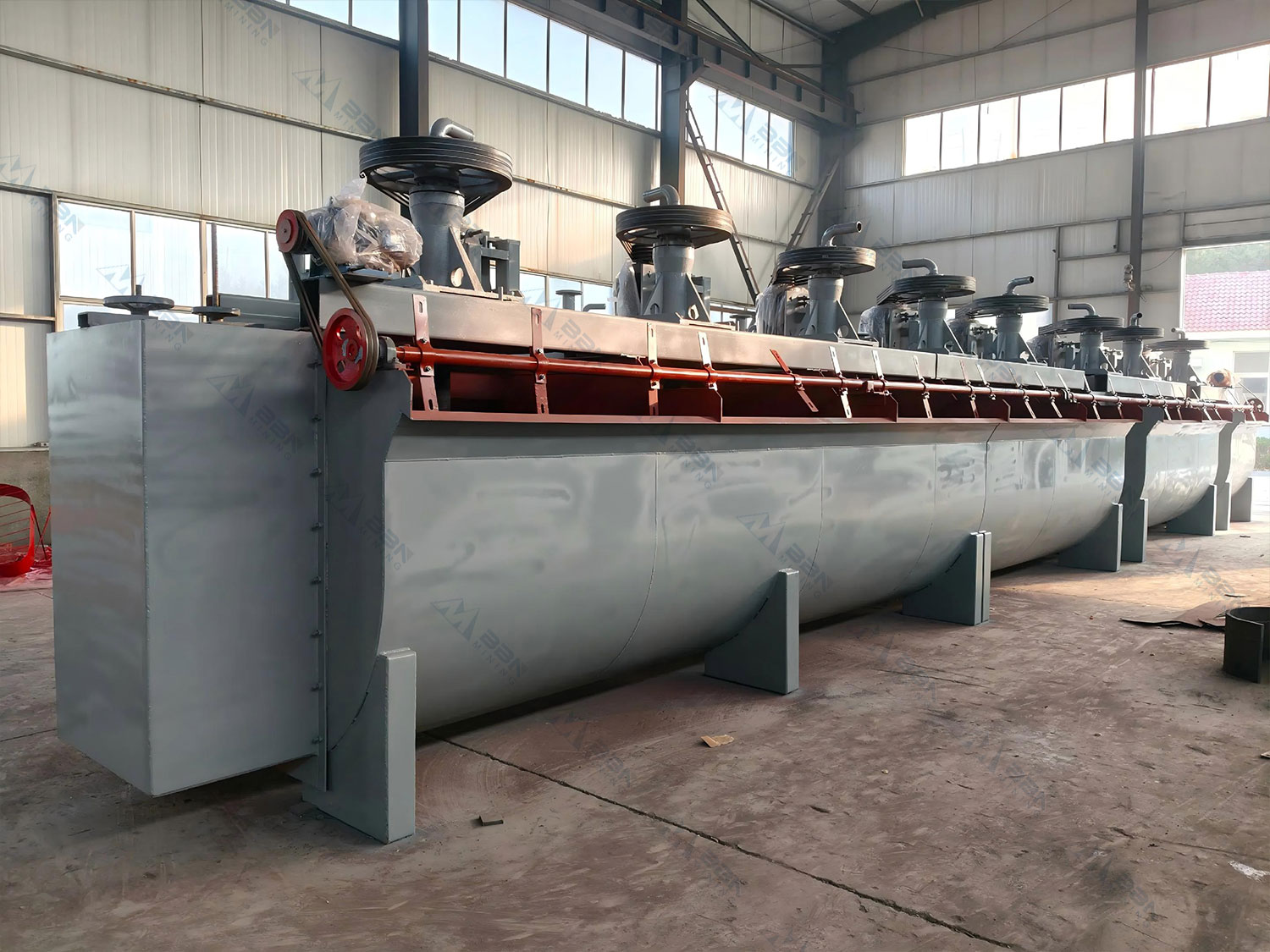
Flotation equipment is key equipment in the mineral processing technology for achieving the separation of minerals from gangue. Its working principle is based on the differences in the physicochemical properties of mineral surfaces, and it realizes the recovery of valuable minerals through processes such as bubble adsorption, mineralization, and flotation separation. Below is a detailed exposition of the working principle of flotation equipment:
I. Basic Principles of Flotation
Flotation utilizes the differences in the hydrophobic-hydrophilic properties of mineral surfaces. By adding flotation reagents, the surface properties of minerals are altered, enabling the target minerals to attach to bubbles and float up to the froth layer, thereby achieving separation from the gangue. The core principles include:
- Differences in mineral surface properties:
- Different minerals exhibit varying degrees of wettability on their surfaces, namely hydrophilic or hydrophobic characteristics. For example, sulfide ores (such as chalcopyrite and galena) typically possess natural hydrophobicity, while gangue minerals (such as quartz and feldspar) are hydrophilic.
- The addition of flotation reagents (such as collectors, frothers, and modifiers) can further enhance or alter the hydrophobic/hydrophilic properties of mineral surfaces, making it easier for target minerals to attach to bubbles.
- Bubble adsorption and mineralization:
- In a flotation machine, a large number of tiny bubbles (typically with a diameter of 0.5-1.5 mm) are generated through mechanical agitation or aeration devices.
- When hydrophobic mineral particles collide with bubbles, due to surface tension, the mineral particles adhere to the bubble surface, forming "mineralized bubbles."
- Hydrophilic mineral particles are unable to attach to bubbles and remain in the pulp.
- Flotation separation:
- Mineralized bubbles float up to the pulp surface under buoyancy, forming a froth layer.
- The froth layer is discharged through scrapers or overflow devices, becoming the flotation concentrate.
- The remaining hydrophilic mineral particles (gangue) remain in the pulp and are discharged as tailings.
II. Working Process of Flotation Equipment
The working process of flotation equipment (such as flotation machines) typically includes the following stages:
- Pulp preparation:
- The ground pulp (with a particle size typically less than 0.074 mm) is thoroughly mixed with flotation reagents (collectors, frothers, modifiers, etc.) in a conditioning tank to ensure uniform adsorption of the reagents on the mineral surfaces.
- The pH value, temperature, and other parameters of the pulp are adjusted to optimize flotation conditions.
- Aeration and agitation:
- After entering the flotation machine, air is introduced into the pulp through mechanical agitation devices (such as impellers) or aeration devices (such as air compressors), generating a large number of tiny bubbles.
- The agitation action ensures thorough contact between the pulp and bubbles, promoting the collision and adhesion of mineral particles to bubbles.
- Bubble mineralization and flotation:
- Hydrophobic mineral particles collide with and adhere to bubbles under the action of agitation and aeration, forming mineralized bubbles.
- Mineralized bubbles float up to the pulp surface under buoyancy, forming a stable froth layer.
- Froth discharge and concentrate collection:
- The froth layer is continuously discharged through scrapers or overflow devices at the top of the flotation machine, becoming the flotation concentrate.
- The concentrate enters subsequent dewatering and filtration processes to obtain the final product.
- Tailings treatment:
- The remaining hydrophilic mineral particles (gangue) remain in the pulp and are discharged from the flotation machine as tailings.
- The tailings can be further processed or discharged to a tailings pond.
III. Key Components and Functions of Flotation Equipment
- Agitation device:
- Typically composed of an impeller and a stator, it is responsible for thoroughly mixing the pulp with air to produce a uniform distribution of bubbles.
- The agitation intensity affects the size, quantity, and mineralization efficiency of bubbles.
- Aeration device:
- Introduces air into the pulp to generate bubbles. Aeration methods include mechanical aeration and self-priming aeration.
- The aeration rate affects the stability of the froth layer and flotation efficiency.
- Tank body:
- Provides space for pulp flow and bubble flotation. The tank structure (such as deep-tank and shallow-tank types) affects the residence time of the pulp and flotation performance.
- Froth scraping device:
- Continuously scrapes out the froth layer that has floated to the pulp surface and collects it as concentrate. The froth scraping speed affects the recovery rate and grade of the concentrate.
- Flotation reagent addition system:
- Precisely controls the addition amount and timing of flotation reagents to optimize flotation performance.
IV. Optimization of Working Parameters of Flotation Equipment
The performance of flotation equipment is influenced by various parameters, and optimal operating conditions need to be determined through experiments and optimization:
- Pulp density:
- Excessively high pulp density can lead to bubble coalescence and reduced mineralization efficiency; excessively low density decreases the processing capacity.
- Aeration rate:
- Insufficient aeration results in a low number of bubbles and incomplete mineralization; excessive aeration may disrupt the stability of the froth layer.
- Agitation intensity:
- Insufficient agitation intensity affects the collision frequency between bubbles and mineral particles; excessive agitation intensity may break up already mineralized bubbles.
- Flotation reagent regime:
- The types and dosages of collectors, frothers, and modifiers need to be precisely adjusted according to the mineral properties and flotation conditions.
- Flotation time:
- Insufficient flotation time leads to a reduced recovery rate; excessive time may decrease the concentrate grade.
Equipment Knowledge
View more
2026-01-14
2026-01-14
Best Sellers
View more products