latest news
View more
What are some common gravity separation equipment?
Time:2026-01-14
Author:
Common gravity separation equipment mainly utilizes the density differences among mineral particles for separation, achieving the separation of valuable minerals from gangue through gravity, centrifugal force, or the action of a medium. Here are several typical gravity separation equipment types, along with their characteristics and application scenarios:
- Jig Machine
- Principle: It employs periodically varying pulsating water flow to stratify mineral particle groups according to density, with heavy minerals settling quickly and light minerals floating on the upper layer, which are then collected separately through a discharge device.
- Characteristics:
- Simple structure, high processing capacity, and high separation efficiency.
- Suitable for separating ores with a wide range of particle sizes (typically 0.5-30 mm).
- Sensitive to density differences in ores, making it suitable for processing minerals with significant density variations.
- Application: Widely used in the separation of metallic ores such as tungsten, tin, iron, and manganese, as well as the pre-selection of non-metallic ores like coal and gold.
- Shaking Table
- Principle: Through the reciprocating motion of the table surface and the action of transverse water flow, mineral particles are stratified on the table surface according to density and particle size, with heavy minerals moving longitudinally along the table surface and light minerals being washed away by the water flow.
- Characteristics:
- High separation accuracy, enabling the production of high-grade concentrates.
- Suitable for processing fine-grained ores (typically 0.037-2 mm).
- Flexible operation, allowing optimization of separation effects by adjusting parameters such as table inclination, stroke, and frequency.
- Application: Commonly used in the concentration of rare metal ores such as tungsten, tin, tantalum-niobium, and gold, as well as the purification of non-metallic ores.
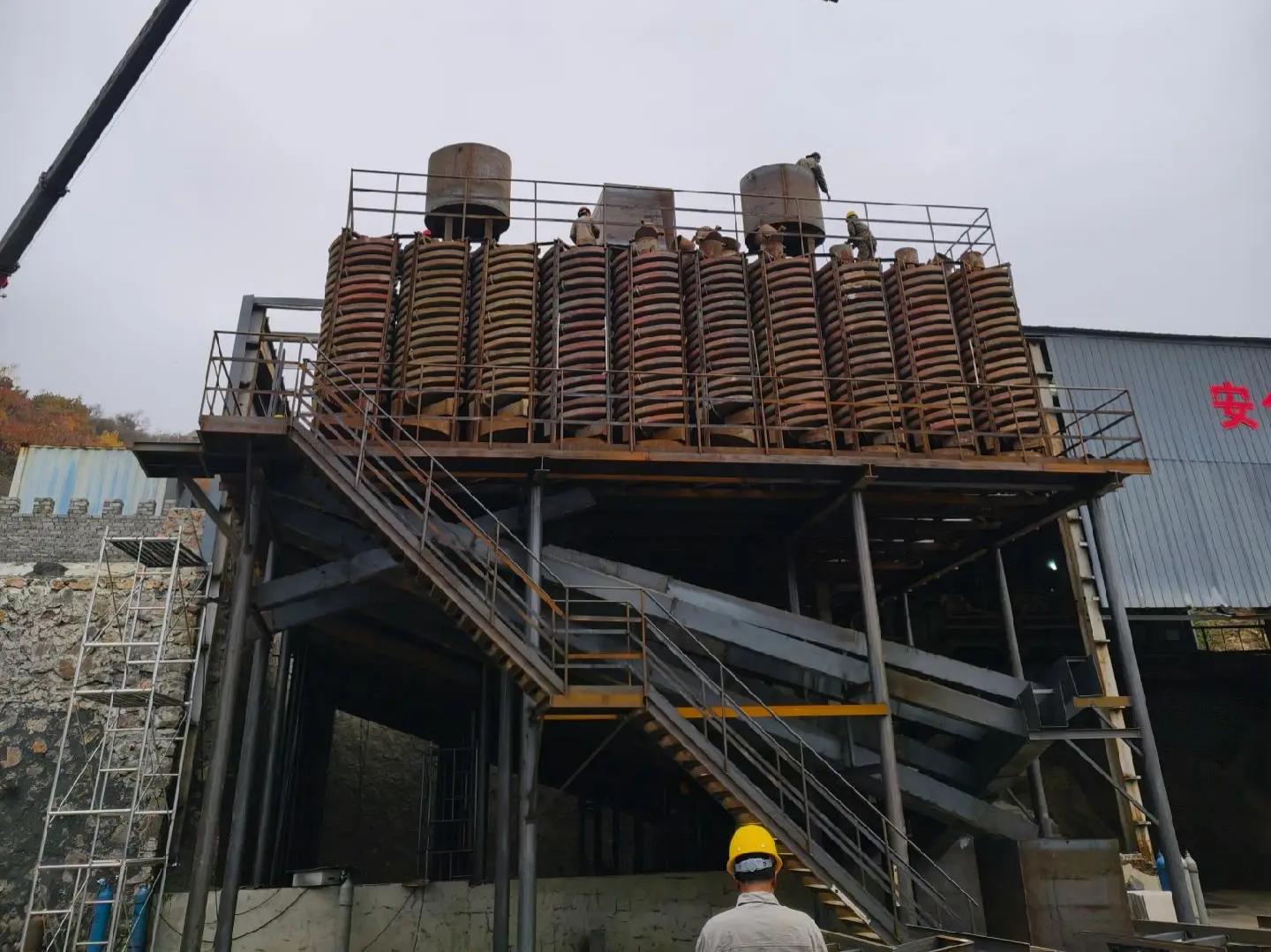
- Spiral Chute
- Principle: It utilizes the differences in centrifugal force, gravity, and frictional force among minerals during their rotational flow in a spiral trough, causing heavy minerals to move along the inner wall of the trough and light minerals to flow outward, achieving stratification and separation.
- Characteristics:
- Simple structure, no power consumption, and low operating costs.
- Suitable for processing medium to fine-grained ores (typically 0.06-3 mm).
- Separation efficiency is influenced by factors such as the pitch, trough width, and slurry flow rate of the spiral trough.
- Application: Widely used in the separation of metallic ores such as iron, titanium, and chromium, as well as the recovery of precious metals like gold and platinum.
- Centrifugal Concentrator
- Principle: It employs the centrifugal force generated by high-speed rotation to enhance the density differences among mineral particles, causing heavy minerals to settle rapidly onto the inner wall of the rotating drum while light minerals are discharged.
- Characteristics:
- High separation efficiency and recovery rate, particularly suitable for the separation of micro-fine-grained minerals.
- Large processing capacity and small footprint.
- Separation effects can be optimized by adjusting parameters such as rotational speed, feed concentration, and wash water volume.
- Application: Commonly used in the recovery of precious metal ores such as gold and silver, as well as the concentration of metallic ores like tungsten and tin.
- Dense Medium Separator
- Principle: It utilizes a dense medium (such as a magnetite powder suspension) with a density greater than water as the separation medium, causing mineral particles to stratify in the medium according to density, with heavy minerals sinking and light minerals floating.
- Characteristics:
- High separation accuracy, capable of processing ores with a wide range of particle sizes (typically 0.5-100 mm).
- Suitable for separating minerals with small density differences.
- Requires a配套 (corresponding) dense medium recovery system, resulting in higher operating costs.
- Application: Widely used in the separation of coal, iron ore, manganese ore, etc., as well as the purification of non-metallic ores.
- Pneumatic Jig
- Principle: It employs compressed air to generate pulsating airflow, causing mineral particles to stratify in the air according to density, with heavy minerals settling and light minerals being carried away by the airflow.
- Characteristics:
- Suitable for arid regions or scenarios with scarce water resources.
- Separation efficiency is influenced by factors such as airflow pressure, frequency, and particle shape.
- Application: Mainly used for the dry separation of coal and iron ore, etc.
- Sluice Box
- Principle: It utilizes the flow of ore pulp in a sluice box and the action of gravity, causing heavy minerals to settle along the bottom of the box while light minerals are discharged with the water flow.
- Characteristics:
- Simple structure, easy operation, and low cost.
- Suitable for processing coarse-grained ores (typically 2-50 mm).
- Relatively low separation efficiency, typically used as a pre-selection device.
- Application: Commonly used in the rough separation of precious metal ores such as gold and platinum, as well as the pre-processing of non-metallic ores.
Equipment Knowledge
View more
2026-01-14
2026-01-14
Best Sellers
View more products